
Introducing Atomic AI: build secure customer experiences that adapt
Use AI inside Atomic Action Flows to turn customer context into more adaptive, personalized experiences


Indy Griffiths
—
Customer input doesn’t always arrive as a neat field or predefined value. It might be a sentence someone typed, the sentiment behind their response, or content written in another language.
Atomic AI can now work with that unstructured input directly. Add an Atomic AI step, describe the task in plain language, and use its output in the rest of your Action Flow.
No vendor to select, no keys to manage, no integration to build. Atomic AI is built straight into Atomic, included in your existing plan with a monthly usage allowance for each environment, and now available in beta for all organizations.
How it works
Add an Atomic AI step to a new or existing Action Flow.
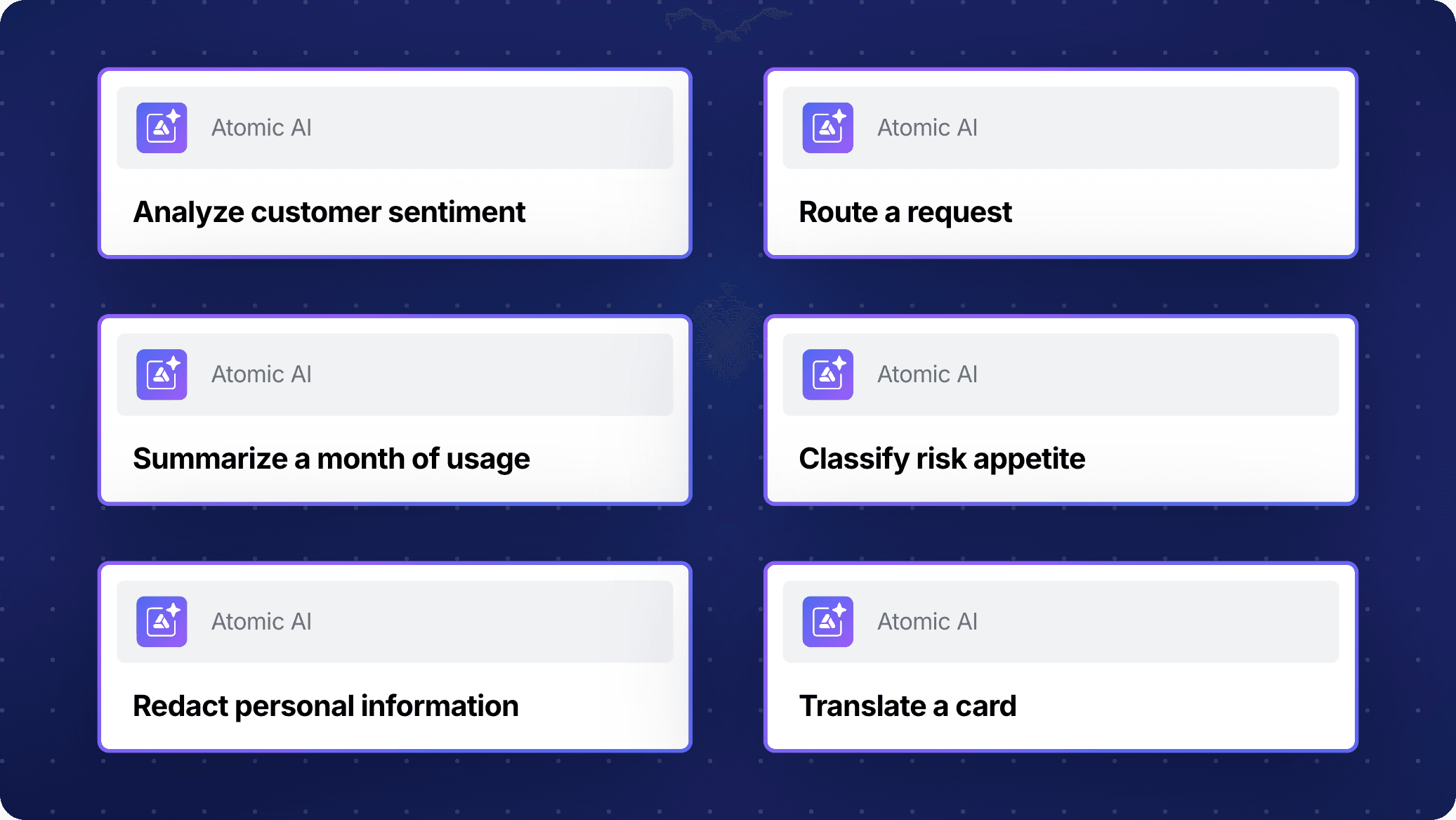
Choose a pre-made example for tasks such as classifying users, analyzing sentiment, or translating content, or write your own instructions from scratch.
Optionally drop in Action Flow variables, card responses, or the output of earlier steps, so your AI instructions are built from that customer's real context.
Choose the capability your task needs, from fast options suited to high-volume work like classification, through to more advanced ones for tasks that need deeper understanding.
You can test and experiment with your instructions and compare the outputs side by side before publishing your Action Flow. Full details are in the Action Flow steps guide.
Suited for every industry
For many enterprises, especially in regulated industries, generating customer-facing copy may not be an appropriate use of AI. Atomic AI can still add value behind the scenes by classifying responses, extracting structured information, summarising inputs and informing branching decisions within an Action Flow.
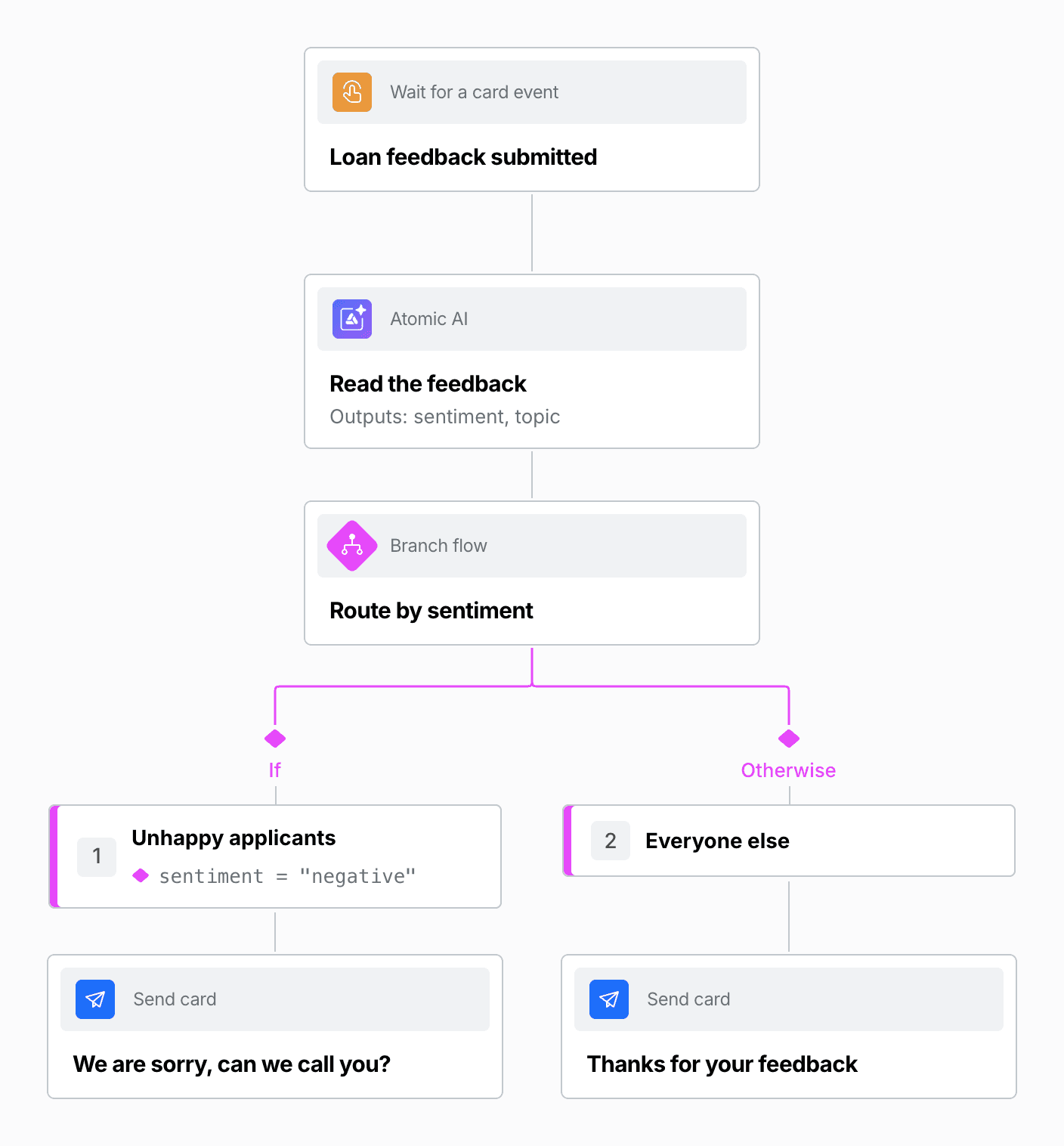
A retail bank asks how a loan application went and gets an essay back. An Atomic AI step works out sentiment and topic, and your Action Flow branches to send either an apology and a callback request for the unhappy ones, or a thank-you card for everyone else.
A council or government agency lets residents describe a request in their own words. The step extracts intent, location and urgency into separate variables, and your Action Flow routes to the right department without anyone triaging a queue.
A utility fetches daily usage for a customer over the last month. Atomic AI composes a summary that highlights usage spikes based on the time or day, and sends a recap card to the customer at the end of the week.
A superannuation or pension fund provider asks a member how they would feel if their balance dropped 15% in a year. An Atomic AI step classifies the response as conservative, balanced or growth, and the Action Flow uses that signal to tailor the next question or help the member understand how their response compares with their current option.
Built to survive a security review
Atomic AI is designed to fit into the security and governance controls your organization already relies on. You are always in control of where it’s enabled, how data is handled, and how usage is monitored.
Opt-in or opt-out by environment. Atomic AI can be enabled or disabled independently for each environment in your organization. You can opt in for some environments and opt out for others.
Nothing is used for training. Rest assured that your inputs or outputs are not used to train the base AI models or third-party AI models, and they aren’t stored by or shared with external AI model providers.
You can audit how Atomic AI was used. For each Action Flow run, the Runs tab lets you inspect the input passed to an Atomic AI step, the output it returned, and what happened next, providing an additional layer of governance and control for your customer data. Atomic also collects analytic events when the step runs, giving you a record of when and where Atomic AI was used. You can trace those events back to an individual run for further investigation. Any output your Action Flow stores in Atomic remains subject to your organization's existing data retention settings.
Atomic AI doesn’t change your data residency. Content is encrypted in transit and Atomic AI is processed in the same AWS region as your Atomic tenant, without being sent to an external AI provider’s infrastructure.
You can track your usage. Atomic AI usage is measured in tokens against a monthly allowance for each environment in your organization. You can see usage broken down by day and by Action Flow, and Atomic notifies administrators as an environment approaches its monthly allowance.
It fails safe. If an Atomic AI step doesn't answer in the configured time, the step falls back to values you set and your Action Flow carries on. Flip one switch and the Action Flow will stop instead, for the cases where the AI answer is genuinely required.
Your existing approval controls still apply. If Approvals are enabled for an environment, Action Flows using Atomic AI must go through the same approval process before they can be published, so an editor can’t introduce or change AI behaviour without the required review and sign-off.
Why Atomic AI
AI is most useful when it has the right context and can do something with the answer. Atomic AI runs inside the Action Flow that is already deciding what happens next for each customer.
Atomic cards run in an authenticated session, so Atomic AI can work with a customer you have positively identified rather than an assumption. Cards are also two-way, so it can use information the customer has directly provided. Profile data, segments and the outputs of earlier Action Flow steps are available in the same flow, without needing to move that context into a separate AI service.
For enterprises, especially those in regulated industries, that opens up AI decisioning without requiring AI to generate customer-facing content. Atomic AI can classify, extract, summarise and interpret customer context, then hand structured outputs back to the Action Flow to decide what happens next.
None of the surrounding infrastructure is new. It is the same authenticated channel, customer profiles, governance and orchestration you already run in Atomic. Atomic AI adds another way to use that context, with the tools you need to govern and trace where AI is used and inspect the outcome.
Try Atomic AI
You can try Atomic AI now in Atomic Workbench. We’ve added a few pre-made examples when creating a new Action Flow to get you started, and we’re excited to see what you build once your Action Flows can work with the context your customers are already giving you.
About the author
Indy Griffiths
Senior Engineer
Indy is a Senior Engineer at Atomic, building product features that help enterprises create more intelligent and adaptive customer experiences.



