
The $260.72 Question: How We Used Atomic to Stop Kiwis Leaving Free Money on the Table
A KiwiSaver provider used Atomic Action Flows to help members understand and claim their annual government contribution before the 30 June deadline. By segmenting members into tailored journeys, personalising cards with contribution data, and adding an in-card top-up action, the campaign reduced confusion, made messages more relevant, and created a repeatable year-round engagement model for future contribution check-ins.

Kat Lowry
—
Every year, on 30 June, a little bit of financial magic quietly expires. In New Zealand, if you're a KiwiSaver member earning under $180,000, aged 16-65, and you've put in enough of your own money, the Government hands you up to $260.72. Free. No catch. Just... free money for saving money.
And every year, a chunk of eligible Kiwis miss out. Not because they didn't want it, but because they didn't know where they stood until it was too late to do anything about it.
This year, one of our KiwiSaver provider clients decided that "too late" wasn't good enough. So we worked with them to engage with their customers on this matter, and we're ready to help the rest of our customers prepare in the same way well ahead of next year's 30th June deadline.
The problem: one deadline, three very different stories
Here's the thing about the government contribution, it isn't a single yes/no. By late June, every member sits in one of three camps:
Sorted - they've already contributed the full $1,042.86 for the year and will get the maximum $260.72, no action needed.
Almost there - they've contributed some money but not quite enough to max it out, and every extra dollar between now and 30 June still earns them 25 cents.
Off track - they've contributed nothing, or aren't eligible this year (turned 65 partway through, joined partway through, etc.), so a blanket "top up now!" message would either be useless or, worse, misleading.
Sending the same in-app message to all three groups is how you end up with confused members, unnecessary support tickets, and (ironically) people who were eligible not bothering to act because the messaging felt like noise.
So instead of one message, we built one Action Flow with three branches.
Solution 1: A Journey that actually knows who it's talking to
We set up a single orchestration (“Action Flow” in Atomic) that checks each member's contribution status against the two things that actually matter: how much they've put in this KiwiSaver year, and how many days they've been eligible for. Then it routes them down one of three paths:
Will receive the full contribution → a "nice one, you're sorted" message, no ask, just reassurance (this matters more than it sounds - it heads off "wait, am I missing something?" support queries).
Almost eligible/partial contribution → a "you're 80% of the way there" message with a clear, specific nudge to close the gap before 30 June.
Will not receive → a message that explains why in plain English (salary, age, eligibility, join date) rather than leaving people to guess - with a pointer to next year if it's a timing issue.
The Action Flow itself does the thinking so the member never sees the branching, they just see the one card that's actually relevant to them.
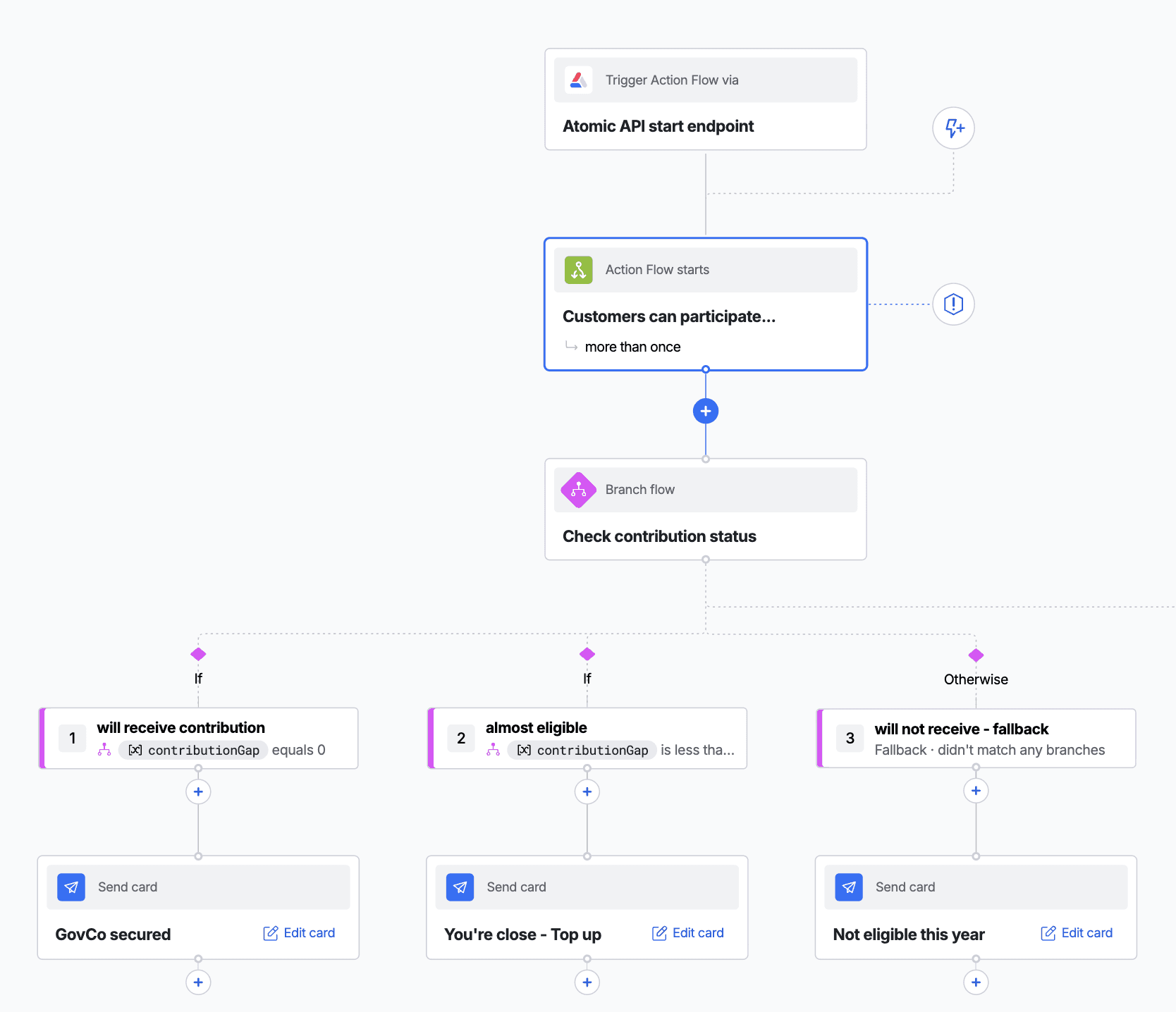
Solution 2: Variables that turn "some Kiwis" into "you, specifically"
The real power here wasn't the Action Flow logic, it was what we filled the messages with. Using dynamic data (“variables”) pulled straight from each member's account, every card could say something specific instead of something generic:
Their exact contribution to date
The exact dollar gap remaining to hit $1,042.86
Their exact projected government contribution based on current pace
Days remaining until 30 June
"You've contributed $780 this year" lands completely differently to "make sure you've contributed enough." One is a fact about you. The other is a suggestion aimed at nobody in particular. Variables are what change a single stock-like template feel like it was written for each member individually.
Solution 3: Don't just tell them - let them act, right there
This is the part where it clicks. A message that tells someone they're short of free money and then leaves them to go find the right form in their KiwiSaver provider’s app is a message that gets ignored. So the "almost eligible" card had a direct action button built into it. One simple tap from the Atomic card straight into a top-up action.
The friction between "I should probably do that" and "done" is where good intentions go to die. Cutting it down to a single tap inside the card itself was the difference between a nice message and a message that actually moved money.
It's also worth calling out that this only works because the action happens inside the app the member is already logged into and trusts. Unlike an email or SMS, there's no need to find a login page, re-authenticate, or trust an external link. The existing authenticated session is used, reducing friction while avoiding phishing risks. For anything involving a member's money, it’s important to provide security and trust. That's a big part of why Atomic exists in the first place.
Solution 4: Build it once, use it all year
Here’s the key bit: the branching logic and the variables behind it (contribution to date, gap to the max, days remaining) don't expire on 30 June. They're just as useful in October as they are in the last fortnight of June.
So rather than treating this as a single end-of-year push, the same Action Flow (or a lighter version of it) can run as a standing check-in layer all year round:
Quarterly nudges - a light-touch "here's where you're tracking" card each quarter, so the gap to the max contribution never sneaks up on anyone in June.
New member onboarding - the moment someone joins KiwiSaver partway through the year, route them into the "almost eligible" branch immediately with the correct pro-rated numbers, rather than leaving them to discover it themselves later.
Life-event triggers - someone turning 65 or otherwise ageing out of eligibility partway through the year could get a heads-up well before the deadline, not a card explaining after the fact why they missed out.
June is when this Action Flow is loudest. It doesn't need to be the only time it runs. Built as an ongoing layer instead of a once-a-year campaign, it turns a single deadline scramble into a year-round habit of members always knowing where they stand.
So, did it work?
The government contribution deadline has now closed for another year (30 June came and went, as it does), so this is very much a "here's what we learned" piece. But the findings are worth putting in your back pocket, because we're already turning them into a repeatable setup for next year:
Segmenting into three distinct journeys, rather than one broadcast message, meant members only ever saw something relevant to them - and relevance is what gets a card read instead of dismissed.
Personalised, variable-driven copy consistently outperformed generic reminders - unsurprising, but nice to have it confirmed with real numbers rather than just a hunch.
Putting the action in the card, rather than pointing at it, was the single biggest lever for people actually topping up before the deadline.
The $260.72 might not change anyone's retirement outcome on its own. But multiplied across a member base, delivered through the right message to the right person at the right moment, running in the background all year rather than scrambling in June, which provides value all year round.
Roll on this financial year and every quarter in between. If you’re looking to get more personalised, timely customer engagement that drives measurable actions and results, we’d love to help you get started!
Figures in this article reflect the KiwiSaver government contribution rules as published by Inland Revenue as of 29 June 2026 (ird.govt.nz). Thresholds, rates, and dates are set by IRD and can change - we always encourage businesses to confirm the current requirements directly with IRD and adjust their Action Flow logic and card copy accordingly, rather than relying on last year's numbers.
About the author
Kat Lowry
Senior Customer Success Manager
Kat manages relationships between Atomic and our customers. Kat shares her trademark wit, friendly smile, and banter with Atomic’s customers and ensures that they are getting the love and product that they deserve.



