
Smarter decisions in every journey: 2026 Q3 Release Recap ♥︎
AI inside Action Flows, real-time observability, new integration steps, deeper Insights, and a demo app you can hold.

Jake Klap
—
Every company is working out where AI fits in their customer engagement. For regulated companies the answer is complicated: letting AI write directly to customers is possible, but it’s challenging and fraught with potential issues. This quarter we shipped a better way to put AI to work. Atomic AI reads, classifies, and interprets what your customers say, then hands the decision back to a journey you control. And that’s only the start of what shipped this quarter.
Here’s what’s new, and what each one unlocks for you.
Atomic AI: the flow controls the journey, AI powers the decisions
Regulated companies have good reasons to keep AI away from customer-facing copy. Atomic AI doesn’t ask you to compromise on that.
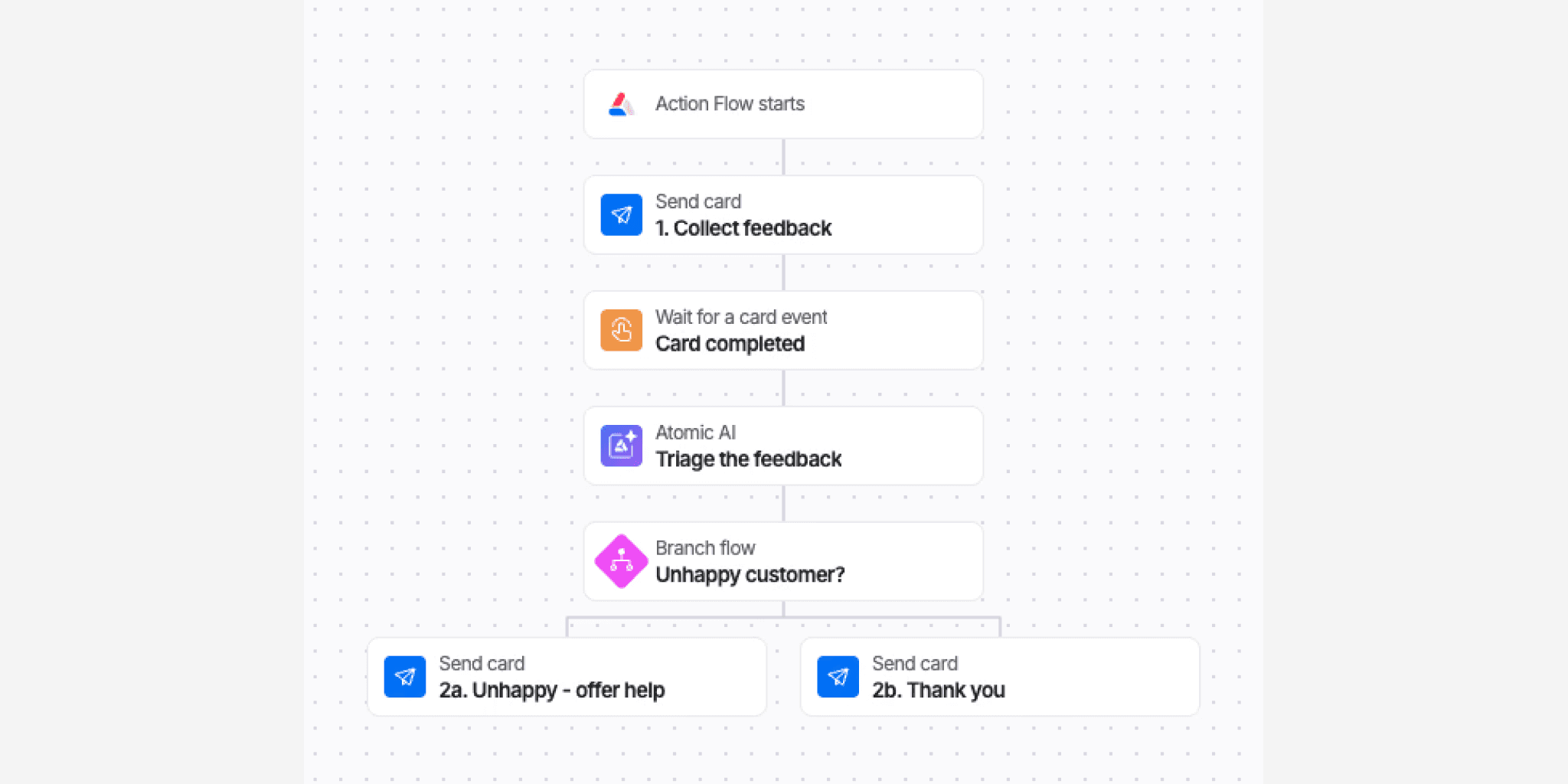
Atomic AI brings AI into Action Flows on your terms. Add an AI step to any flow and describe the task in plain language: classify a response, analyse sentiment, extract structured information, summarise, or translate. Then use the output anywhere downstream. The AI never has to write a word your customer sees. It works behind the scenes, interpreting context and handing structured decisions back to the flow.
Picture it in practice. A bank customer leaves free-text feedback after a declined loan application; Atomic AI reads the sentiment and topic, and the flow branches to an apology and a callback, or a thank-you. A council receives a free-text service request; the AI extracts intent, location and urgency, and the flow routes it to the right department. A super fund asks an open question about risk appetite and gets back a clean conservative/balanced/growth classification to act on.
It’s built to survive a security review. There’s no AI vendor to select, no keys to manage, and no integration to build. Your inputs and outputs are never used to train models or shared with external providers, your data residency is unchanged (processing stays within your tenant’s region), and it’s opt-in per environment with fail-safe fallbacks and full support for existing approval controls. It’s included in your plan with a monthly token allowance per environment.
Read the full Atomic AI announcement →
The Runs tab: see exactly what happened, as it happens
Automation you can’t inspect is automation you can’t trust. This is a problem that gets worse the moment AI joins your flows.
The new Runs tab, now in beta for all organisations, gives you a single place to inspect any individual Action Flow run in real time: the status of each step, branch decisions, resolved variable values, card and notification previews, and the analytic events fired along the way. If you’re using Atomic AI, it’s your audit trail: exactly what the AI saw, what it returned, and what the Action Flow did next. And when something doesn’t go to plan, it now tells you why a run didn’t start or why a push couldn’t be sent, with troubleshooting steps.

New pre-configured steps: Databricks, SMS via Sinch, and email via Amazon SES
The best customer journeys live inside your app. Pre-configured steps make them even stronger, extending Action Flows with ready-made integrations to third-party services.
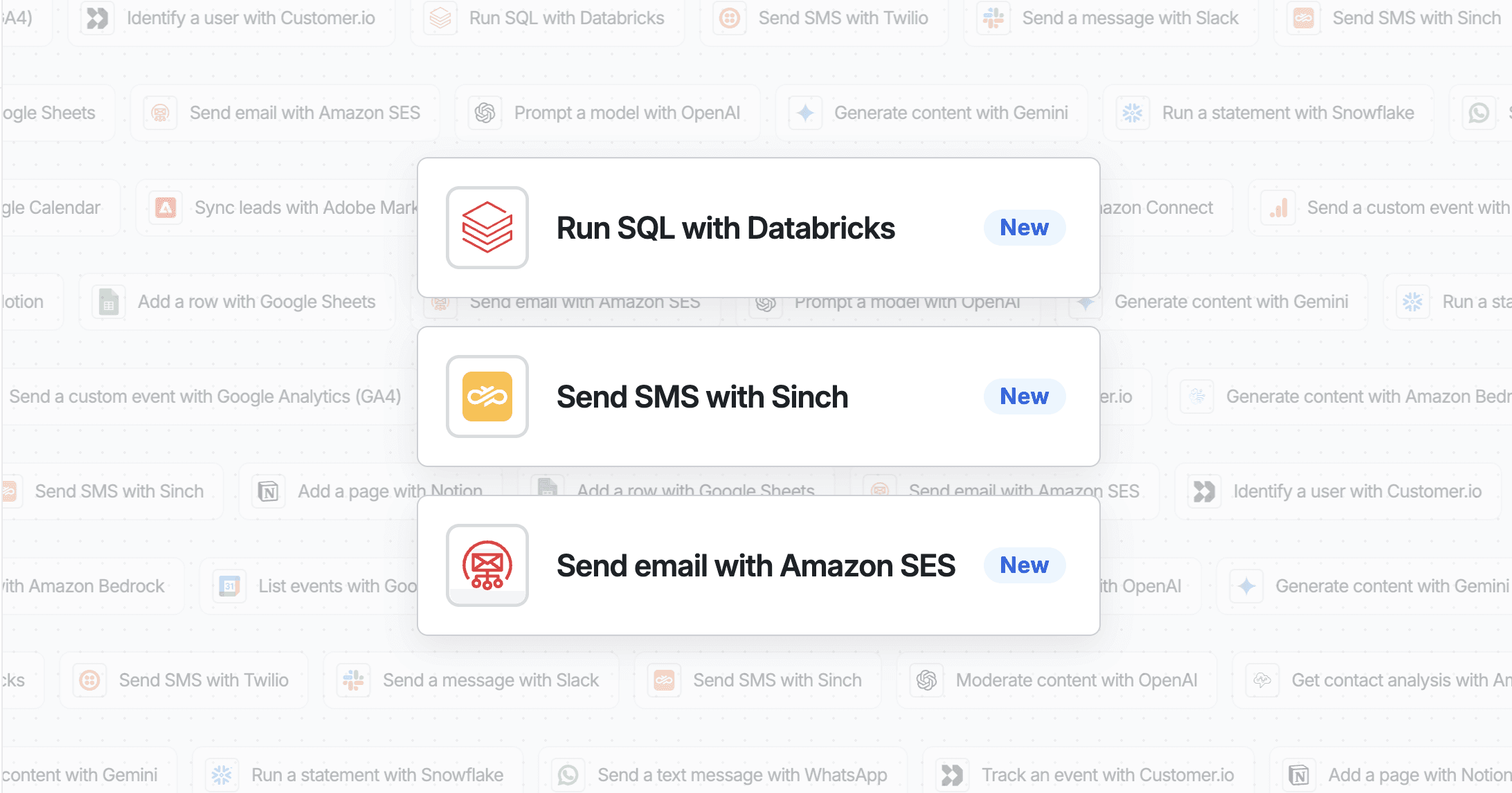
This quarter, Action Flows gained three new pre-configured steps. The Databricks step lets an Action Flow run SQL against a Databricks SQL warehouse mid-journey: pull lakehouse data in to personalise an experience, or write card responses straight back into a Delta table where your analysts and models can use them. SMS via Sinch adds a complementary channel: send a message, check delivery status, and act on replies, all as native steps. And email via Amazon SES rounds out the set, sending through your own credentials and infrastructure. So a single Action Flow can use the right channel for each moment: act on a card in your app, confirm it by email or SMS, and follow up with the next card when the time is right.
No custom integrations, no glue code. Your stack becomes part of the journey.
These three join an existing catalogue of pre-configured steps spanning the likes of Snowflake, Twilio, WhatsApp, Slack, Notion, and Customer.io.
Insights: compare and discover, without leaving Atomic
“Is this actually working?” usually means manual comparison: this week against last week, iOS against Android, one campaign against another, juggled across browser tabs and spreadsheets.
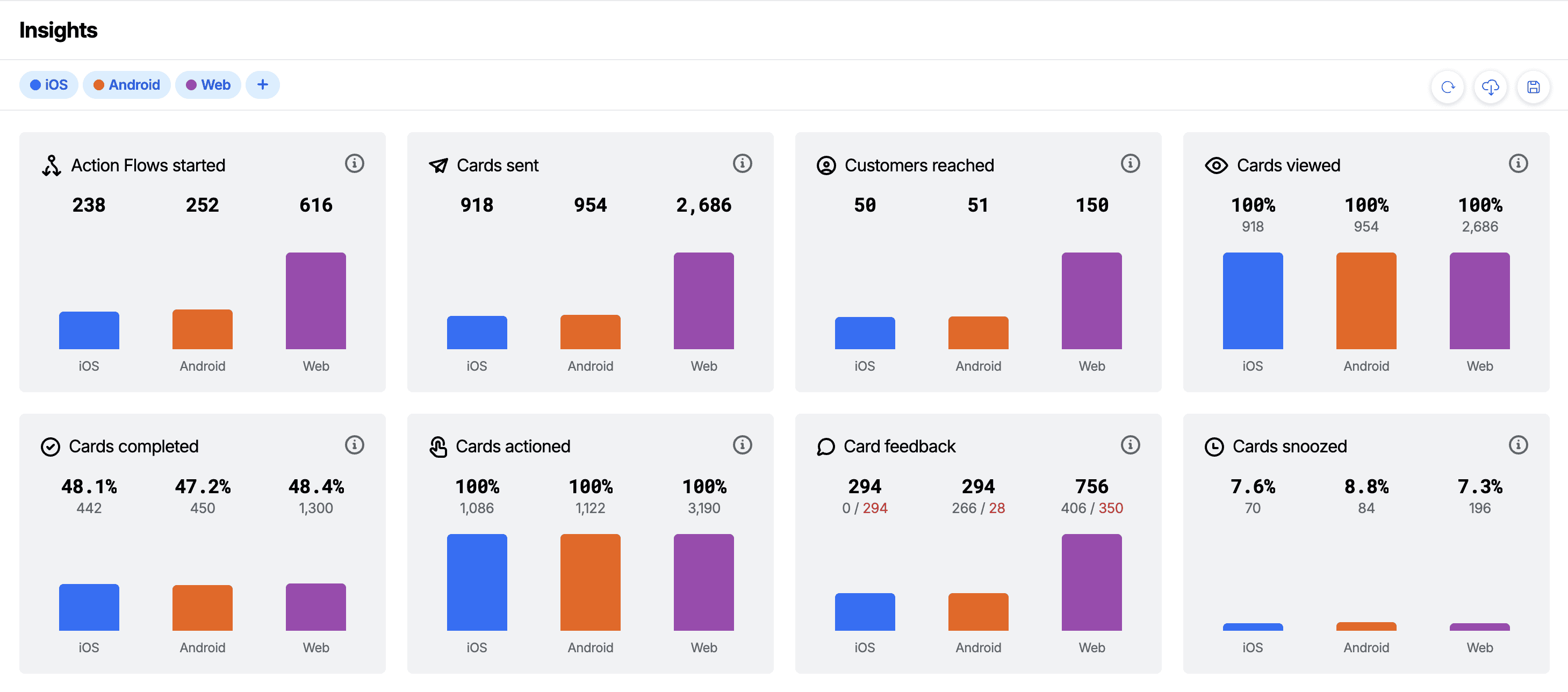
Insights now answers that question in place. Build multiple filter sets and see them side by side across the whole dashboard, with one coloured bar per set on every tile. A retail bank can watch read rates move week over week; a telco can split every metric by platform in one click; an insurer can compare two onboarding flows and see which drives more completed actions, without exporting a thing. Add to that the new Lifetime mode for measuring the complete long-run performance of cards, and richer exports that now include custom events.
Atomic Explore: put the product in your pocket
In-app messaging is one of those things that’s hard to explain and instantly obvious the moment you experience it.
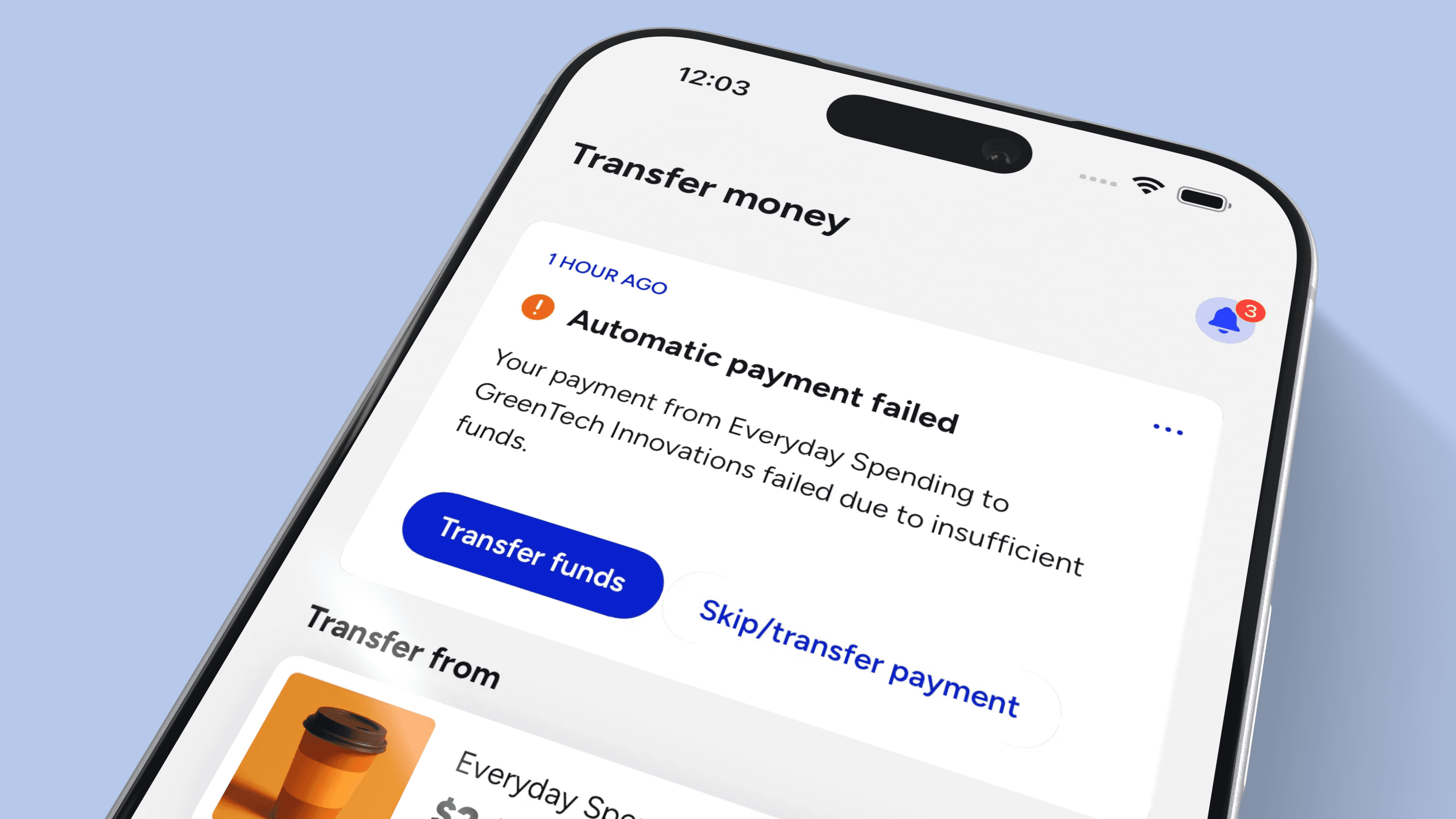
That’s why we built Atomic Explore, our fully interactive demo banking app. This quarter it arrived on Android, joining its iOS sibling (which picked up updates of its own). It’s built natively in Kotlin and Jetpack Compose on our modern native SDK (no WebViews, no wrappers) with real push notifications, a live notification centre, and multiple Atomic placements woven through realistic banking journeys. Anyone on your team can experience the customer-facing side of Atomic in about two minutes, before a single meeting or line of code.
Get it on Google Play or the App Store.
Also this quarter
Stronger governance. Approvals can now require sign-off from distinct individuals and prevent submitters approving their own flows. More of the enterprise-grade controls our customers rely on.
A more complete Customer Center. Support and operations teams can now see a customer’s push notifications, device registrations, Action Flow instances, segments, and events in one place, making “what did this customer receive, and why?” a one-stop question.
A modernised SDK line-up. Major releases across React Native (New Architecture), Flutter, Android Jetpack Compose, SwiftUI and Web, with new layouts, text variants, accessibility improvements, and expanded certificate pinning.
Beyond these, there were dozens more enhancements and bugfixes, all detailed in our changelog.
The bigger picture
Each release is useful on its own. Together, they point in one direction: journeys that make smarter decisions, informed by AI, grounded in your data, observable end to end, and governed to enterprise standards. That’s what we mean by smarter decisions in every journey.
As always, we’d love to talk through anything here in more detail. Book a 30-minute demo, reach out with a question, or get hands-on with Atomic Explore and the examples library.
Stay tuned as there’s plenty more coming before the year is out. 👋
About the author
Jake Klap
Principal Consultant
Jake Klap supports Atomic’s customers to design and execute highly-effective customer engagement programmes through Atomic and guides potential customers through their evaluation and consideration of Atomic.



